Hi-Tech Security Systems - Human Factor Articles
Contributing Editor - Dr Craig Donald
The Impact of Human Factors in CCTV - October, 1997, Vol 3 No 6.
Click here for Human Factors Articles - Visit the Human Factor Discussion Forum
The area of CCTV is continually driven by an ever increasing sophistication and variety of products and systems designed to enhance the scope and effectiveness of surveillance and the use of information. However, as the implementation of CCTV systems matures and top management look more critically at costs versus outcomes, there is an increasing need to ensure that the capital invested in this technology is having an impact on the bottom line. The human factors related to CCTV are becoming increasingly recognised as critical in ensuring that the technology works and produces results. Increasingly, industry standards committees are looking at factors outside the traditional technical areas.
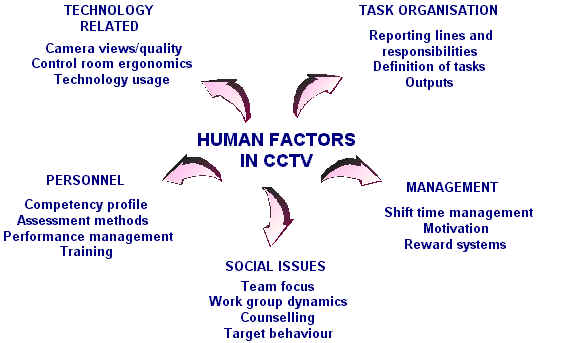
Human factors are those people related issues that impact on the way the technology is designed, arranged, and utilised. The technology should therefore be in line with certain specified goals, the way in which work is organised, and the capacity and health of people. The realisation of the potential of CCTV technology and the effectiveness of its implementation is therefore dependent on the areas illustrated in Figure 1.
Technology related human factors have been influencing CCTV systems and particularly camera technology and its development for some time. The defining of acceptable picture quality through recognition tests and fulfilling legal requirements for evidence has led to greater attention in the selection of equipment and the use of reference tables for camera and lens selection. The Rotakin target developed by the UK Police Scientific Development Branch (PSDB) is a practical way in which one can assess whether the camera technology meets the necessary human factor requirements. The PSDB also comprehensively highlight another important aspect of technology implementation - that of defining precise operational requirements for the technology. In their CCTV Operational Requirements Manual they provide a methodology to allow one to define exact requirements to which the technology is going to be used. For example, one aspect of the decision making is whether the purpose of the system is to monitor, detect, recognise or identify targets in the surveillance situation. This will determine, for instance, whether only the recognition of a person’s presence is necessary or a clear view of body language is required, whether visual identification of a suspect or an object is critical or not, and hence the necessary capability of equipment. A decision also needs to be taken on operator discretion and flexibility in the use of equipment. There may be times when operator’s can contribute substantially by innovative use of the technology in looking at the surveillance targets but in others there is room for abuse and a more limited range of options may be imposed. A more thorough consideration of system needs will avoid situations where money is spent on technology which is redundant or inappropriate even before installation.
The design of control rooms and even control panels represents a particular area which highlights the need for increased consideration of human factors. Often both the control room environments and consoles are a matter of convenience rather than optimising efficiency of use. Alternatively, they are a showcase of the technology rather than facilitating operator usage. Some simple problems evidenced in some control rooms are things like the positioning of blank screen technology right next to a main surveillance monitor and directly in the field of vision. This leads to operators complaining of constant distractions and even eyestrain as flickering pictures interfere with the direct surveillance task. Consoles which lead to personnel gazing upwards at angles of 60 degrees not only lead to aching neck and back muscles, but divert attention from the screen as operators frequently change position in order to reduce the discomfort. Surveillance is a difficult enough job without being physically punished while having to do it. Lighting, seating, identifying which monitors require the most attention, the use of multiplexes, positioning of screens and alarm/view based considerations all play a part in design. Increasingly, ergonomics specialists are getting involved in the design of UK control rooms, but even a thorough consideration of practical issues and taking an operator perspective before installation can lead to improved control room conditions. Another important aspect of system design is the accessibility of system components for maintenance, repair and replacement. However good things look, at some stage they will need to be worked on and provision needs to be made for this.
The personnel area reflects an increasing emphasis in CCTV. As more sophisticated measures of performance evaluation and benchmarking of system and personnel effectiveness come into effect, it becomes clearer that operators can differ significantly in performance. This reflects three conditions: the specification of what kind of people are required, whether the right people are selected, and follow through training. De Beers are probably one of the world leaders in the way they have looked at CCTV personnel. Getting an optimal structure in the surveillance sections that would cover surveillance, technical aspects, data management, review, and analysis aspects was seen as critical as CCTV systems were implemented across the Group. Competency profiles on the various positions were drawn up and significant effort has gone into the process of selecting people in line with these specifications. At one of the De Beers operations for instance, a combination of instruments looking at surveillance skills (using SAMAE), personality assessment, testing of conceptual ability, assessment centre exercises which look at behaviour in simulations, and pre- and post-training recognition of non-verbal behaviour is being implemented to profile capabilities of surveillance staff.
Training of personnel is probably an area that is lagging behind technology and the implementation of systems. Training has largely being aimed at technical familiarisation with the equipment followed by on the job learning or technical training for people responsible for maintaining the systems. It has also often been ad hoc as people are exposed to certain systems or equipment. More recently, non-verbal behaviour recognition training has been initiated in companies like JCI and CTU which takes the surveillance process one step further. It can be anticipated that surveillance skills themselves will become a focus of training in future.
Performance management of surveillance staff is also assuming greater priority where performance can be measured. Benchmarking of expected or average detection rates allows one to highlight where people are not meeting the norm and this can be followed by training, and if this fails to assist, with redeployment. In some operations, detection rates (including confirmed occurances) are being graphed on a weekly or monthly basis to highlight performance issues. In some cases these graphs are made accessible to the operators in order to stimulate performance. In other operations things like reaction time and computer logged misses are being used to indicate success in performing.
A range of social issues gets generated with the implementation of a CCTV system. This affects both the surveillance personnel and the people being viewed. Internally, issues such as contact between people while doing surveillance is an issue. Should operators be working alone or in conjunction with each other? What social interaction is allowable and what is not? Do you get operators to compete with each other on performance indicators and if so what impact may this have on team spirit and possibly even pressure on high performers to conform to lower levels? The control room is also a relatively small place and where people are together for extended periods some facilitation and handling of conflict situations will inevitably be required. Where operators are exposed to situations which may result in them viewing violent behaviour and even trauma, consideration of provision for counselling should be made and decisions made of what kind of support functions should exist. Externally, how are people going to react to being monitored, can you anticipate what measures may be attempted against equipment and can it be protected? In the UK, there is a high level of sensitivity to public views in situations where municipal surveillance is done - there is a clear acknowledgement by the police that while people are generally in favour of CCTV in a community protection role, should the mood turn against having CCTV the systems could be seriously compromised.
The organisation of tasks and procedures to be taken when something is detected are literally the aspects responsible for turning the identification of something through surveillance into meaningful action. These ensure that everything that needs to be covered is covered, and people are clear about their involvement and necessary reactions. Reporting lines must be established, responsibilities need to be defined, accountability allocated, standards laid down, communication channels indicated, and forms or computerised reporting of incidents and occurrences established. The PSDB in their information sheet for town centres provide a context in which to view requirements for operational responses, the observer role, and issues such as who should get involved, priorities, and tolerances. De Beers utilise what they call job effectiveness descriptions which incorporate not just the activities or tasks that are required from a job, but also key performance areas and indicators which indicate what outcomes are seen as necessary for those tasks to be completed successfully. This focus on outcomes builds in performance standards and expectations which personnel are aware of. Task organisation also addresses the system checks such as how things will be audited, levels of review, and measures to ensure continuity of system performance including handover procedures. An essential aspect of task organisation that is often neglected is generating adequate documentation on system installation, particularly if contractors are involved. Follow up maintenance and knowing the location of equipment and routing of cables is greatly simplified if this is clear and documented from the beginning.
The management of the CCTV system clearly has a number of important human factor issues. The appropriate structure, reporting lines and responsibilities outlined in sections above are obviously relevant in this area. Related to this is how directly involved supervisors get in the process, what kind of videotape management system is set up, who liaises with outside organisations etc? However, other areas such as the initiation and management of shifts, ongoing motivation of personnel, and what kind of reward systems can be even more important. For example, research into attention spans show people are typically most effective in concentrating over thirty minute periods. Yet, having frequent breaks interferes with the continuity of surveillance and establishing an understanding and recognition of behaviour and patterns that are being observed. A balance needs to be established between these two influences if people are to be effective, perhaps having people rotating once every one to three hours. Clearly, extended periods of beyond three hours of continual surveillance are likely to lead to deterioration in performance. The decision to rotate personnel within the function also needs to be considered in the context of the operation and whether this is feasible.
Motivation of staff is accomplished through a combination of effective management practices, performance management and recognition. Given that surveillance is a somewhat isolated job, it is important that personnel feel part of a unit and appreciated. In companies which have implemented feedback procedures on reported incidents, operators report that they feel significantly more motivated by seeing the consequences of their actions and by being acknowledged. The display of incident detection rates for operators to view is another approach but one which must be carefully handled. While some competition is good, it can also demoralise people. In this kind of situation, performance issues need to be addressed through training or coaching so people feel something constructive is being done. The use of reward systems is also a contentious issue. Given that the job of surveillance is about detecting incidents, why should people get paid more for when they do this. On the other hand pay is still a strong motivator and bonuses for performance is a way of stimulating effort. However, the personal recognition and involvement of personnel is probably the most effective way of motivating performance.
The human factors related to CCTV operation go well beyond the traditional man-machine interface. In various ways and in differing aspects of the environment in which the CCTV operation must operate, human factors form a critical part in ensuring the success of the operation. This article describes some of the aspects that need to be considered. The following article will provide a flow chart of how these and others fit into the process of establishing, installing and getting the CCTV system operational.
References: CCTV Operational Requirements Manual, Publication No17/94, Home Office Police Scientific Development Branch, Sandridge, 1994.
© Hi-Tech Security Systems